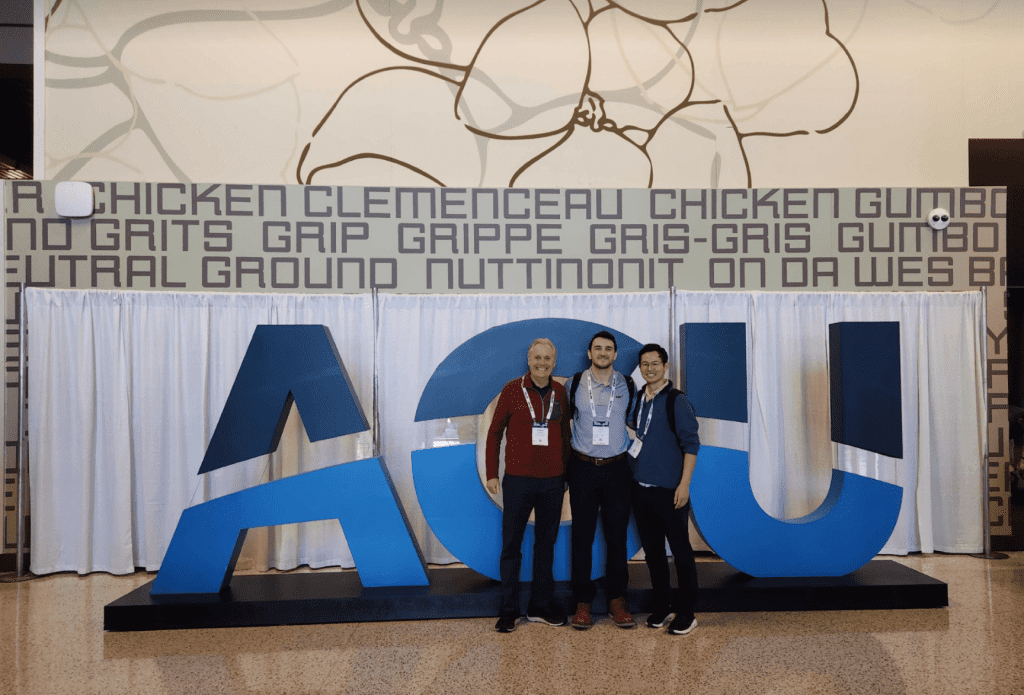
At the 2025 American Geophysical Union (AGU) Fall Meeting in New Orleans, LA, ERT staff presented several technical innovations that support U.S. federal agencies in computational hydrology, flood inundation modeling, and continental-scale Earth system data management. ERT presentations emphasized our work integrating Artificial Intelligence and Machine Learning (AI/ML) methods with traditional full-physics modeling and large-domain data mapping to enhance the scalability and precision of products from the National Water Model NextGen Water Prediction program of the National Oceanic and Atmospheric Administration’s (NOAA) National Weather Service.
Jeff Arnold, ERT’s Chief Innovation Officer, was pleased to see ERT’s high-fidelity tools for enhanced national water security and hazard mitigation presented in the December annual meeting. They represent significant milestones for ERT’s thought leadership supporting U.S. federal applied space and Earth science. “With more than 25,000 geoscientists, engineers, practitioners, and policymakers attending the 2025 Fall Meeting,” Jeff said, “we had a terrific opportunity to showcase ERT’s deep capabilities and some of the specific products that illustrate our 30+ year commitment to the space and Earth science and engineering that enhance U.S. national and economic security.”
Scalable Evaluation Frameworks for Flood Inundation Mapping
Dylan Lee’s poster, “Enhancing NOAA’s National Flood Inundation Mapping Evaluation System with Scalable Container Orchestration,” described his work supporting enhancement of NOAA’s National Flood Inundation Mapping (FIM) Evaluation System through cloud-native container orchestration. This architecture uses AWS and HashiCorp Nomad products to facilitate a fifteen-fold increase in evaluation throughput. By transitioning to a modular, containerized environment, the system enables the rapid benchmarking of multi-model ensembles against continental-scale datasets. Preliminary results indicate that this scalable framework effectively quantifies the impact of physiographic features on model bias, offering a robust mechanism for integrating novel modeling techniques into future operational workflows.
“My poster presentation was well attended, and I got a chance to talk with multiple stakeholders of different responsibilities about the new flood model evaluation system. I was also able to see new work at AGU that has the potential to inform our work on this contract.”
Automated Repurposing of Hydraulic Models for Real-Time Forecasting
Abdul Siddiqui’s oral presentation, “Advancing NOAA’s Near Real Time Flood Inundation Mapping Capabilities with Ripple1D and Flows2FIM,” described the development of the Ripple1D and Flows2FIM case bases and datasets. These tools automate the re-purposing of archived HEC-RAS model outputs into forecast-ready libraries that enable faster and more accurate operational forecasts using real-time stream flows as a novel solution for advancing near-real-time flood inundation mapping and analytics. Those maps and analyses measurably improve emergency response, national security, and resilience. Leveraging the real-time streamflow data, the system generates high-fidelity flood maps with minimal latency. To date, Abdul’s products have enabled processing of 100,000+ FEMA models which has extended enhanced flood-risk visibility to regions encompassing approximately 90 million U.S. residents, significantly improving the spatial resolution of emergency response frameworks for areas within 1 mile of the library domains.
“I had the pleasure of presenting our flood mapping work to a room filled with modelers and data scientists, and the emergency response professionals who use these products,” Abdul said. “AGU is the premier conference in the world for getting people who make geospatial and geophysical tools like ours together with those who use them.”
Differentiable Routing and Lakehouse Architectures
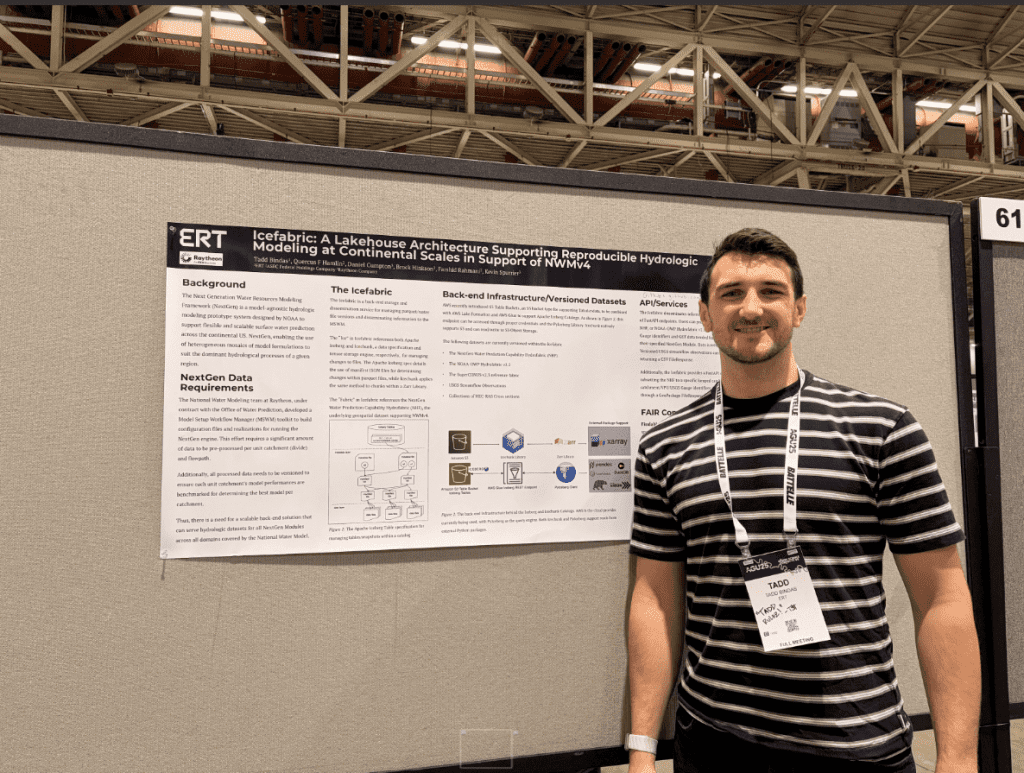
Tadd Bindas gave both an oral presentation, “Distributed Differentiable Routing on the CONUS Hydrofabric,” and a poster, “Icefabric: A Lakehouse Architecture Supporting Reproducible Hydrologic Modeling at Continental Scales in Support of NWMv4” where he described two technical achievements in the continuing development of NOAA’s National Water Model (NWM) v4 framework which ERT supports. The Distributed Differentiable Routing method applies a scalable, differentiable Muskingum-Cunge approach to the CONUS Hydrofabric which can help improve accuracy of flood magnitude and timing predictions in the national model products. The Icefabric architecture is a means for meeting data management challenges in modeling up to 800,000 catchments for the U.S. using Apache Iceberg for version-controlled, reproducible workflows to provide better calibration and regionalization of continental-scale hydrologic datasets in multi-institutional collaborative environments.
“The back-end services applications presented in my sessions were well received. Researchers, government, and industry professionals across different domains at AGU were interested in the presented strategies,” said Tadd Bindas.
Machine Learning-Driven Parameter Regionalization
Yuqiong Liu’s oral presentation, “From Calibration to Prediction: Enabling Large-Scale Hydrologic Modeling through Formulation and Parameter Regionalization in NextGen,” described the work she supports in large-scale hydrologic modeling for ungauged basins with an emphasis on how regionalization can most accurately transfer model formulations and parameters from calibrated to uncalibrated basins for improved accuracy in data-sparse locations. Within the NextGen National Water Model framework, a Python-based suite was developed to implement ML-driven clustering and efficient regionalization. By pairing donor (calibrated) and receiver (uncalibrated) catchments based on physical similarity and proximity, this method can improve streamflow simulations and enhance the transferability of model formulations across diverse hydro-climatic landscapes.
“It was very helpful for me to give my talk in a session dedicated to similar problems and solutions,” Yuqiong said, “and to have the opportunity across AGU to network with my ERT colleagues and with so many other experts in the broader research and applications communities.”
The AGU Fall Annual Meetings continue to be an unparalleled opportunity for ERT to demonstrate our evolving capabilities across the range of federal space and Earth science and engineering missions we support. The talks and posters presented in December 2025 on modular, AI-integrated, and cloud-scalable hydrologic science and data engineering were substantial signs of how our capabilities continue to expand to include new methods and applications.
“AGU 2025 was a very strong finish to this calendar year of dedicated investment for innovative growth at ERT for the federal science and engineering missions sets we support,” CIO Jeff Arnold said. “And we’re very excited to continue that investment and momentum in 2026.”